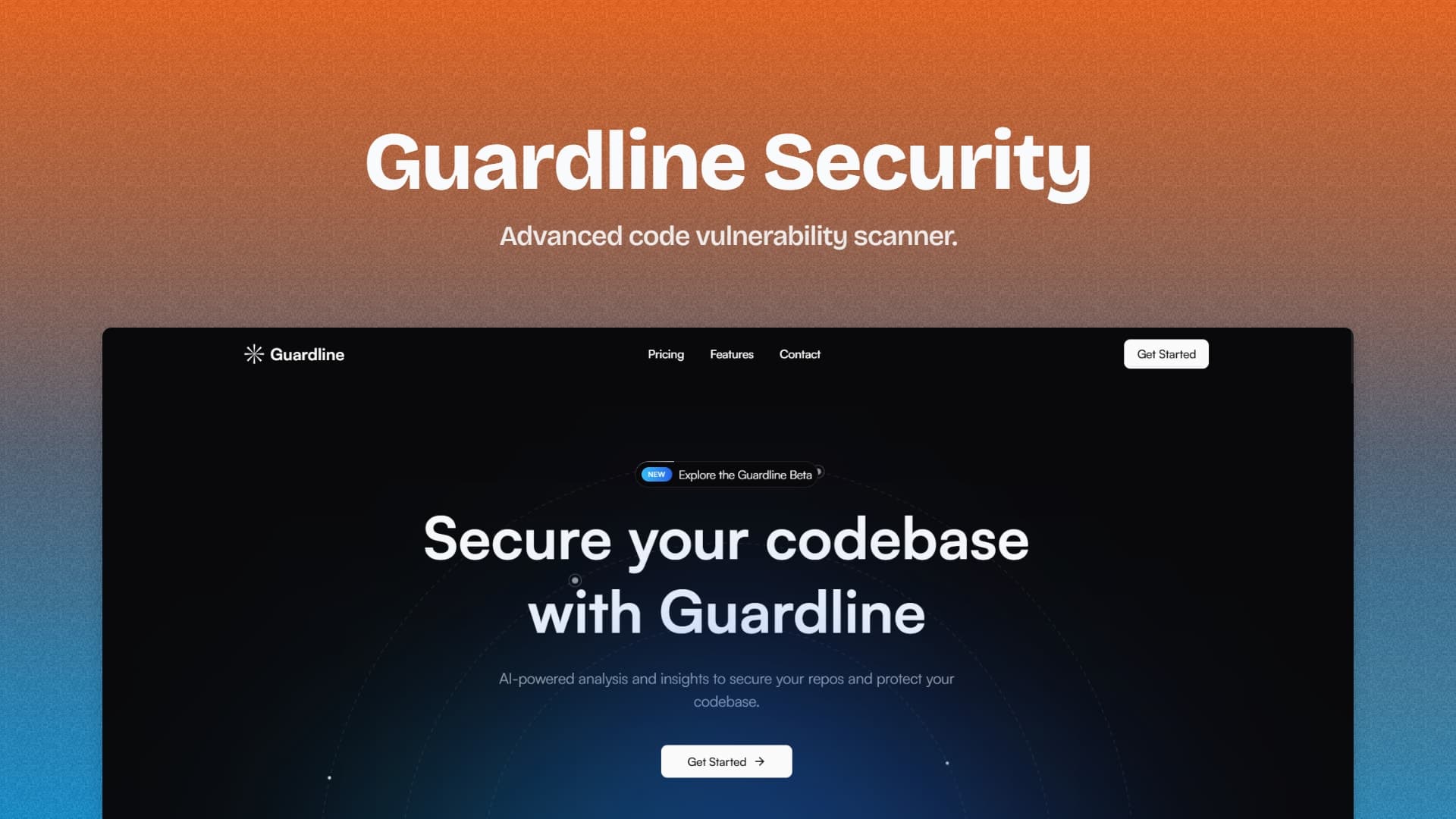
Overview
Modern software development increasingly prioritizes speed and rapid deployment, often at the cost of security. As applications grow more complex, vulnerabilities become harder to detect manually, leading to increased risk in production environments. Guardline Security was developed to address this challenge by delivering an intelligent code vulnerability scanning system designed to enhance secure development practices through automation and precision.
Rather than functioning as a basic scanning tool, Guardline Security operates as a security-focused analysis system capable of evaluating source code, identifying vulnerabilities, and providing actionable insights. The platform is designed to integrate seamlessly into modern development workflows, enabling developers to identify and resolve security issues early in the development lifecycle.
Problem Statement
Despite the availability of security tools, many development workflows still lack efficient and accessible vulnerability detection mechanisms. Traditional approaches often rely on manual reviews or fragmented tools, which can result in missed vulnerabilities and inconsistent security practices.
A significant challenge lies in detecting vulnerabilities across diverse codebases while maintaining accuracy and performance. Many systems struggle with identifying insecure dependencies, misconfigurations, and risky coding patterns without generating excessive false positives. Additionally, integrating security analysis into existing workflows without disrupting developer productivity remains a complex problem.
The objective was to design a system capable of performing reliable static analysis while maintaining scalability, accuracy, and seamless integration with modern development environments.
System Architecture Strategy
Static Analysis Engine
Guardline Security was designed around a static analysis engine that evaluates source code without executing it, enabling early detection of vulnerabilities during development. The system leverages principles of Static Application Security Testing to identify insecure patterns, dependency risks, and potential misconfigurations within applications.
The architecture ensures that analysis is performed efficiently while maintaining a balance between detection accuracy and performance. By focusing on structured code evaluation, the system provides meaningful insights without overwhelming developers with unnecessary noise.
Scalable Backend Processing
The backend of Guardline Security is built using Node.js, enabling efficient handling of scanning processes and report generation. The system is designed to process multiple codebases concurrently while maintaining consistent performance.
This approach allows the platform to scale with increasing workloads while ensuring reliable execution of analysis tasks. It also supports modular processing, making it easier to extend the system with additional security rules and detection mechanisms over time.
Automated Scanning Workflow
To improve usability and efficiency, the platform incorporates an automated scanning workflow that streamlines the process of analyzing codebases. The system is capable of initiating scans, processing results, and generating reports without requiring extensive manual intervention.
This automation reduces the effort required from developers while ensuring that security checks are consistently applied across projects. It also supports integration into development pipelines, enabling continuous security validation.
Reporting & Insight Generation
Guardline Security includes a structured reporting system that transforms raw analysis data into clear and actionable insights. Instead of presenting complex technical outputs, the platform organizes findings in a way that helps developers quickly understand vulnerabilities and take corrective action.
This improves decision-making and allows teams to prioritize critical security issues effectively, ultimately enhancing overall application security.
Core Capabilities
Guardline Security is designed to identify vulnerabilities within source code by analyzing patterns, dependencies, and configurations. The system provides automated scanning capabilities that ensure consistent security checks across projects while minimizing manual effort. Its architecture supports scalable processing, allowing it to handle multiple analyses efficiently. The platform also delivers structured and actionable reports that help developers understand and resolve security issues with clarity and precision.
Key Learnings
The development of Guardline Security reinforced the importance of integrating security directly into the development lifecycle rather than treating it as a separate phase. It highlighted the challenges of balancing detection accuracy with performance, especially when analyzing large and complex codebases. The project also emphasized the need for clear and actionable reporting, as effective communication of vulnerabilities is essential for improving developer adoption and response.
Additionally, it demonstrated that scalable and modular system design is critical for building security tools that can evolve alongside modern development practices and emerging threat landscapes.
Outcome
Guardline Security represents a robust and scalable vulnerability scanning system designed to support secure software development practices. The platform delivers efficient static analysis capabilities, automated workflows, and actionable insights, enabling developers to identify and mitigate security risks early in the development process.
The project demonstrates the ability to design and implement security-focused systems that align with modern standards in application security, DevSecOps, and scalable backend engineering.